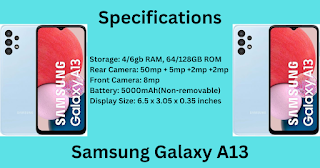
Samsung Galaxy A13 Phone Features, Specifications and Price - Owtech solutions


Samsung galaxy A13 specifications


The Samsung Galaxy A13 is one of the most popular and ordered devices. It takes over 1%  of all the smartphones sold today. In recent research, the Samsung galaxy A13 took the second spot in the best-selling smartphones not just in the Samsung Galaxy A series devices but globally. 

Here are some of the features that make the Samsung Galaxy A13 popular.\

Samsung Galaxy A13 Phone Features:

This Samsung Galaxy A13 boasts a 50mp rear camera that guarantees quality images and videos to help you capture those special moments. It also has an 8mp selfie camera which beats similar phones within its price category.

Samsung Galaxy A13 Specifications and Features:

Display Features:

  • 6.5 x 3.01  x0.35 inches
  • Resolution: 1080 x 2408 pixes
  • 400 PPI density
  • Contrast ratio: 4,500,000:1
  • Color gamut: DCI-P3
  • Brightness: HBM 700 nits (typ), 1100 nits peak brightness (typ)
  • 8-bit color
  • Reading mode 3.0
  • Sunlight mode 2.0
  • Low blue light certified by SGS

Processor Capacity

  • MediaTek Helio G95
  • CPU: Max CPU frequency 2.05 GHz
  • GPU: ARM Mali-G76 MC4

Storage & Memory

  • 6GB RAM
  • 128GB Storage
  • LPDDR4X + UFS 2.2

Camera Specifications

  • 50MP wide-angle camera
    • 1/1.97" sensor size
    • 0.7μm pixel size
    • f/1.79
  • 5MP ultra-wide angle camera
    • 118° FOV
    • f/2.2
  • 2MP macro camera
    • f/2.4
  • 2MP depth sensor
    • f/2.4
  • Rear camera photography features
    • 50MP mode
    • Night mode
    • AI Beautify
    • AI portrait mode with bokeh and depth control
  • Rear camera video features
    • Video macro mode
    • Pro time-lapse video
    • Slow motion video
  • Rear video recording
    • 4K, 3840x2160 at 30fps
    • 1080p, 1920x1080 at 60fps
    • 1080p, 1920x1080 at 30fps
  • 8Arc-sideMP front camera
    • f/2.45

Network & Connectivity

  • GSM/HSPA/LTE
  • Dual SIM

Network bands:

  • 2G: GSM 850 900 1800 1900 MHz
  • 3G: WCDMA B1/2/4/5/8
  • 4G: LTE FDD B1/2/3/4/5/7/8/20/28
  • 4G: LTE TDD B38/40/41(2535-2655MHz)
  • Wireless Networks
  • 2.4GHz/5GHz Wi-Fi
  • Navigation & Positioning
  • GPS: L1
  • Galileo: E1, Glonass: G1, Beidou

Audio Specifications

  • Loud speaker
  • 3.5mm headphone jack
  • Hi-Res Audio certification

Sensors

  • Proximity sensor
  • Ambient light sensor
  • Accelerometer
  • Gyroscope
  • Electronic compass
  • Linear vibration motor
  • IR Blaster
  • Fingerprint sensor, side-mounted

Operating System

  •  Android 12 
  • CPU: Octa-core
  • GPU: PowerVR GE8320side-mounted

Battery & Charging

  • 5000mAh
  • 15W fast charging
  • Type C charging system.
Weight - about 205g(7.23 0z)

The Samsung Galaxy A13 costs around $250(Between Kshs.27,000 to 30,000).
See Buying Options:

JUMIA AMAZON ALIEXPRESS SAMSUNG STORE


Disclaimer: We do not guarantee that the information on this page is 100% accurate. The phone specifications and prices change over time. Do further research or consult the respective vendors for information.


Comments

Contact Form

Name

Email *

Message *

Popular posts from this blog

Samsung Glaxy M-series Phones Features and Specifications

Are you planning to buy a samsung m-series smartphone? Here is a list of all the m-series options and there features and specificications: Samsung Galaxy M10: Display: 6.22 inches, HD+ Infinity-V Processor: Exynos 7870 Octa-core RAM: 2GB/3GB Storage: 16GB/32GB (Expandable) Camera: Dual - 13MP (main), 5MP (ultra-wide) Battery: 3400mAh OS: Android 8.1 (Oreo) Samsung Galaxy M20: Display: 6.3 inches, FHD+ Infinity-V Processor: Exynos 7904 Octa-core RAM: 3GB/4GB Storage: 32GB/64GB (Expandable) Camera: Dual - 13MP (main), 5MP (ultra-wide) Battery: 5000mAh OS: Android 8.1 (Oreo), upgradable to Android 10 Samsung Galaxy M30: Display: 6.4 inches, FHD+ Super AMOLED Processor: Exynos 7904 Octa-core RAM: 4GB/6GB Storage: 64GB/128GB (Expandable) Camera: Triple - 13MP (main), 5MP (ultra-wide), 5MP (depth) Battery: 5000mAh OS: Android 8.1 (Oreo), upgradable to Android 10 Samsung Galaxy M40: Display: 6.3 inches, FHD+ Infinity-O Processor: Snapdragon 675 Octa-core RAM: 6GB Storage: 128GB (Non-expandabl...

iPhone 17 – Leaks, Rumored Specs, and What to Expect

  The tech world is buzzing again , Apple’s iPhone 17 is on the horizon, and leaks are giving us an exciting glimpse into what could be the most refined iPhone yet. Set to be announced in September 2025 , the iPhone 17 brings subtle but meaningful upgrades across performance, display, and design. Here's a detailed breakdown of everything we know so far, from leaked specs to expected pricing and new features. Summary of Key Rumored Specs Display: 6.3-inch LTPO OLED, 120 Hz Chipset: Apple A18 (3 nm), 8 GB RAM Camera: 48 MP main + 12 MP ultrawide, 24 MP selfie Battery: Improved efficiency, MagSafe charging Design: Slimmer Dynamic Island, familiar build OS: iOS 26 Price: Expected $899 (US), ₹79,900 (India), AED 3,799 (UAE) Expected Launch Date Apple traditionally launches new iPhones in early to mid-September, and the iPhone 17 is expected to follow suit , likely becoming available globally by late September or early October 2025. Display: Bigger and...

Google Ends the 16GB Android Era: What the New 32GB Minimum Means for Everyone

Google has quietly but decisively ended the era of 16GB Android smartphones. With the rollout of Android 15, any phone that wants to ship with Google apps—including essentials like the Play Store—must now have at least 32GB of internal storage and 2GB of RAM. Devices that fall below this threshold are relegated to the lighter, stripped-down Android Go Edition, or lose access to Google Mobile Services (GMS) entirely This change is more than a technical footnote. It signals a major shift in the Android ecosystem, with far-reaching implications for developers, manufacturers, retailers, marketers, and consumers alike. Why Google Raised the Bar Apps Are Heavier, Expectations Are Higher The days when 16GB could comfortably house the Android OS, a handful of apps, and some photos are long gone. Modern apps—especially those with rich media, AI features, and offline capabilities—are significantly larger. Even so-called “lite” apps have grown in size, and the Android system itself continues to ...

Sponsored Links

View More